General Relativity: Gravity as Geometry
Einstein's theory of gravity replaced invisible forces with curved spacetime, and in the process rewrote our picture of black holes, cosmology, light, and time itself.
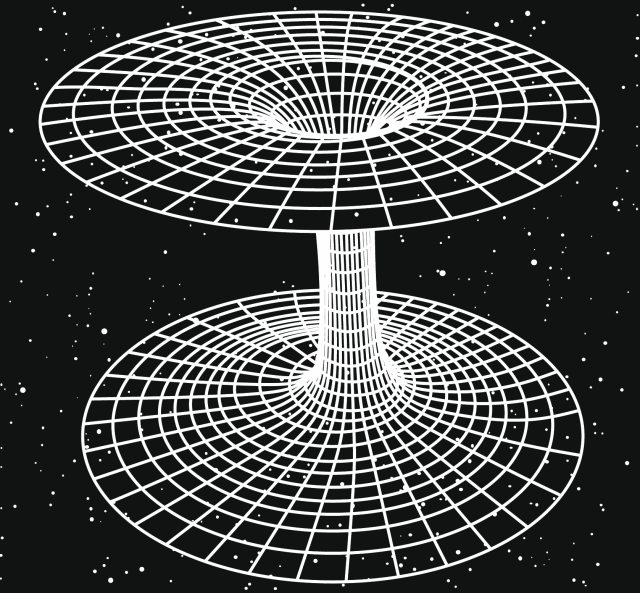
Isaac Newton's law of gravitation was one of the greatest achievements in the history of science. It explained falling apples, planetary orbits, tides, and comets with a compact mathematical rule. For everyday engineering and most celestial mechanics, it still works beautifully. But by the early twentieth century, cracks had started to show.
Newtonian gravity acts instantaneously across space, while Einstein's special relativity had already established that no influence can propagate faster than light. Newton's theory also had trouble with precise measurements, most famously the small extra precession in Mercury's orbit. Einstein's answer was radical: gravity is not a force in the ordinary sense at all. It is the shape of spacetime.
1915
Einstein completes the field equations of general relativity.
43"
Per-century anomalous precession of Mercury explained by the theory.
1.75"
Deflection of starlight at the Sun's limb, confirmed in 1919.
2015
LIGO directly detects gravitational waves for the first time.
Where Newton falls short
Newton's universal gravitation describes a force between any two masses proportional to the product of their masses and inversely proportional to the square of the distance between them:
This force acts instantaneously. If the Sun were to suddenly vanish, Newtonian gravity would have the Earth respond immediately, even though the event is 8 light-minutes away. This is incompatible with special relativity, which forbids superluminal signaling. Any theory of gravity compatible with relativity must propagate gravitational influence at finite speed.
The empirical crack was Mercury. After accounting for the gravitational tugs of all known planets, the perihelion of Mercury's orbit still advances by about 43 arcseconds per century more than Newton predicts. This tiny residual had resisted explanation for decades. Le Verrier, who had successfully predicted Neptune from similar anomalies in Uranus, proposed a hidden planet ("Vulcan") near the Sun. It was never found.
These were not just aesthetic complaints. They pointed to a genuine incompleteness in Newtonian physics. What was needed was a theory that reproduced Newton's successes in the weak-field, low-speed regime while making different predictions where Newton fails — near massive bodies, at high speeds, and over cosmological distances.
From force to geometry
In Newton's picture, matter sits in a passive stage called space and time. Objects move around on that stage while forces push and pull them. General relativity changes the stage itself. Space and time fuse into a single four-dimensional structure — spacetime — and that structure becomes dynamical. It bends, stretches, and ripples in response to the matter and energy it contains.
The key change is conceptual. Instead of asking, "What force pulls the Earth toward the Sun?" Einstein asks, "What geometry does the Sun create around itself, and how does the Earth move inside that geometry?" The Earth is not being yanked off a straight path. It is following the straightest path available in a curved spacetime — a geodesic.
Matter tells spacetime how to curve, and spacetime tells matter how to move. — John Archibald Wheeler
That line is not the whole theory, but it captures the right intuition. Geometry is no longer bookkeeping. Geometry becomes the mechanism of gravitational interaction.
The equivalence principle
Einstein's bridge into the theory was the equivalence principle. It comes in several forms, but the essential idea is this: gravitational and inertial mass are the same. A freely falling observer does not feel their own weight. Locally, free fall is indistinguishable from the absence of gravity.
Imagine you are sealed inside an elevator. If the cabin is in free fall in a gravitational field, objects you release float beside you — you are weightless. Now imagine the elevator far from any planet, but accelerating upward at . A ball dropped from your hand falls to the floor exactly as if gravity were present. No local experiment can distinguish between the two situations.
Weak equivalence principle: all bodies fall with the same acceleration in a gravitational field, regardless of mass or composition. This is Galileo's observation, tested to one part in by modern torsion balance experiments.
Einstein equivalence principle: in a small freely falling laboratory, the laws of physics reduce to those of special relativity. Gravity reappears only when you compare nearby freely falling paths and notice they converge, diverge, or twist. That relative behavior is curvature.
The equivalence principle has immediate consequences. If light travels in straight lines in a freely falling elevator, then in a gravitational field light must bend. If clocks tick at the same rate in a freely falling elevator, then clocks at different heights in a gravitational field must tick at different rates. Both predictions follow before you write down a single equation.
Curved spacetime
Once gravity is understood as geometry, the next question is what exactly is being curved. The answer is spacetime itself. Distances and durations are measured by a metric, a mathematical object that tells you how to compute the spacetime interval between neighboring events.
The metric tensor
In flat spacetime, special relativity uses the Minkowski metric:
In general relativity, the metric becomes a field — a set of ten independent functions of position and time, , that encode the full geometry of spacetime:
The metric does everything. It determines the distance between points, the angle between vectors, the rate at which clocks tick, the paths of freely falling particles, and the trajectories of light rays. Knowing the metric is knowing the gravitational field completely.
The popular rubber-sheet analogy is both helpful and misleading. It helps because it makes clear that geometry can guide motion. It misleads because the real theory involves time as much as space. The reason the Earth orbits the Sun is not that it rolls around a spatial dent. The Sun changes the structure of spacetime — including the rate at which clocks tick — and the Earth follows a geodesic in that four-dimensional geometry.
Geodesics
A geodesic is the generalization of a straight line to curved geometry. On a sphere, the geodesics are great circles. In spacetime, a freely falling massive particle traces a timelike geodesic that extremizes the proper time between two events:
The are the Christoffel symbols, built from derivatives of the metric. They encode how the coordinate grid is twisting and stretching. In flat spacetime all the Christoffel symbols vanish and the geodesic equation reduces to uniform straight-line motion. In curved spacetime they produce what we experience as gravitational acceleration.
Light follows null geodesics, where . This is why light bends around massive objects — not because a force acts on photons, but because the straightest available path in curved spacetime is itself curved relative to a distant observer's coordinate grid.
The Einstein field equations
All of this intuition condenses into one of the most important equations in modern physics:
On the left is geometry. The Einstein tensor is built from the Ricci tensor (which measures how volumes change along geodesics) and the Ricci scalar (its trace). The cosmological constant accounts for the energy density of empty space.
On the right is matter and energy, packaged into the stress-energy tensor . This includes mass density, pressure, momentum flux, and stress — not just mass. Pressure gravitates. Energy gravitates. Even gravitational energy itself contributes, though in a subtle way because the field equations are nonlinear.
The field equations are ten coupled, nonlinear partial differential equations for the ten independent components of the metric. They are extraordinarily difficult to solve in general. Most known exact solutions exploit symmetry: spherical symmetry (Schwarzschild), axial symmetry (Kerr), or cosmological homogeneity (Friedmann–Lemaître–Robertson–Walker).
In the weak-field, low-speed limit the field equations reduce to Newton's Poisson equation for gravity, . General relativity does not discard Newton. It contains Newton as a limiting case.
The Schwarzschild solution
Within months of Einstein's publication, Karl Schwarzschild found the first exact solution: the metric outside a spherically symmetric, non-rotating, uncharged mass. In Schwarzschild coordinates:
where is the Schwarzschild radius. This solution encodes gravitational time dilation, the bending of light, the precession of orbits, and the existence of black holes — all in a single line.
Several features are immediately visible. At the component vanishes: time stops for a static observer at the horizon (as seen from infinity). The component diverges, signaling a coordinate singularity — not a physical one. The physics is perfectly regular at the horizon; only the coordinate system breaks down. At there is a genuine curvature singularity where tidal forces become infinite.
Classical tests
A good physical theory earns trust by surviving contact with observation. General relativity passed its first tests within years of publication and has continued to pass increasingly stringent ones ever since. The original three classical tests remain instructive.
Perihelion precession of Mercury
In Newtonian gravity, a planet orbiting a central mass in isolation traces a perfect ellipse that remains fixed in space. Perturbations from other planets cause the ellipse to precess slowly. For Mercury, the total observed precession is about 5600 arcseconds per century. After subtracting 5557 arcseconds due to other planets and frame-dragging effects, a 43-arcsecond residual remained unexplained for decades.
General relativity predicts an additional precession of
For Mercury this gives about 42.98 arcseconds per century, matching the observed residual precisely. This was the first quantitative success of the theory, and Einstein later said it gave him heart palpitations.
Chart: GR precession by planet (arcseconds per century)
Bending of light
Newtonian gravity can be made to predict light deflection if you treat a photon as a particle with mass, giving a value of 0.875 arcseconds at the solar limb. General relativity predicts exactly twice that: 1.75 arcseconds. The factor-of-two difference comes from the curvature of space in addition to the curvature of time.
where is the impact parameter (distance of closest approach). During the solar eclipse of May 1919, expeditions led by Eddington measured the deflection of stars near the Sun. The results, while noisy by modern standards, were consistent with Einstein's prediction and made headlines worldwide. Modern radio-interferometry measurements have confirmed the GR value to better than 0.01%.
Chart: Light bending falls off with distance from the Sun
Gravitational redshift
A photon climbing out of a gravitational well loses energy. Since a photon's energy is proportional to its frequency, the frequency decreases — the light is redshifted. The fractional change for a photon emitted at radius and received at infinity is
On Earth's surface the effect is tiny — about one part in — but it has been measured with exquisite precision. The Pound–Rebka experiment in 1959 used the Mössbauer effect to detect the gravitational redshift over a 22.5-meter tower at Harvard, confirming the prediction to about 1%. Modern atomic clock comparisons have verified it to parts per million.
Chart: Gravitational redshift vs. radial distance
Gravitational time dilation
Gravitational redshift is intimately connected to time dilation. A clock at radius in a Schwarzschild geometry ticks at a rate
relative to a clock at infinity. Clocks deeper in a gravitational well run more slowly. This is not a mechanical effect on the clock — it is a property of spacetime itself. Any physical process runs slower: chemical reactions, biological aging, radioactive decay.
Chart: Gravitational time dilation near a Schwarzschild radius
The practical consequence most people encounter is GPS. Each satellite orbits at roughly 20,200 km altitude, where gravity is weaker than at the surface. Their clocks gain about 45 μs per day from the gravitational effect. Special relativistic time dilation from their orbital speed subtracts about 7 μs per day. The net correction is roughly 38 μs per day. Without it, GPS positions would drift by about 10 km per day — the system would be useless.
Gravity Probe A (1976) launched a hydrogen maser clock on a rocket to an altitude of 10,000 km and compared it with an identical clock on the ground. The measured gravitational redshift agreed with GR to 70 parts per million — one of the most precise tests of the equivalence principle to that date.
Black holes
Push enough mass into a small enough region and an event horizon forms at the Schwarzschild radius. Inside that boundary, all future-directed paths lead inward toward the singularity. Nothing — not even light — can escape. This is a black hole.
For decades black holes were treated as mathematical curiosities. That changed as observational evidence accumulated: X-ray binaries like Cygnus X-1, the supermassive compact object Sagittarius A* at the center of the Milky Way (whose mass of ~4 million solar masses is inferred from stellar orbits), and the Event Horizon Telescope's direct imaging of the shadow around M87* in 2019.
Orbits and the ISCO
In Newtonian gravity, stable circular orbits exist at any radius. In general relativity, the effective potential for radial motion acquires an additional term from the relativistic correction:
(in geometrized units). The new term creates a potential barrier that shrinks with decreasing angular momentum. Below a critical value, the barrier disappears entirely and no stable circular orbits exist. The innermost stable circular orbit (ISCO) occurs at for a non-spinning black hole.
Interactive: Schwarzschild Radius Calculator
Adjust the mass to see the size of the event horizon if that mass collapsed into a non-rotating black hole.
Chart: Effective potential for orbits around a Schwarzschild black hole
Chart: Circular orbital velocity around a Schwarzschild black hole
The ISCO is physically important because it sets the inner edge of an accretion disk. Matter spiraling inward radiates energy efficiently until it reaches the ISCO, then plunges rapidly into the black hole. The efficiency of energy extraction from accretion onto a Schwarzschild black hole is about 6%, rising to 42% for a maximally spinning Kerr black hole.
Singularities and horizons
The horizon at is a one-way membrane. An infalling observer crosses it in finite proper time and notices nothing locally special — the equivalence principle ensures that spacetime looks flat in a small neighborhood. But once inside, the radial coordinate becomes timelike: moving toward smaller is as inevitable as moving forward in time outside.
At lies a genuine singularity where curvature invariants diverge. The singularity theorems of Penrose and Hawking show that singularities are generic in GR: given reasonable energy conditions, gravitational collapse inevitably produces them. This is widely regarded as a signal that the classical theory breaks down and must be replaced by a quantum theory of gravity in the deep interior.
Rotating black holes are described by the Kerr metric (1963). They have an ergosphere — a region outside the horizon where spacetime is dragged so strongly that no observer can remain stationary. The Penrose process allows energy extraction from the ergosphere, in principle reducing the black hole's spin.
Gravitational waves
If changing electric charges radiate electromagnetic waves, then changing mass-energy distributions should radiate gravitational waves — ripples in the fabric of spacetime that propagate at the speed of light. Einstein predicted them in 1916, though he initially doubted their physical reality.
In the weak-field linearized theory, gravitational waves appear as small perturbations on a flat background. They are transverse and come in two polarizations (plus and cross). The leading-order radiation comes from the time-varying quadrupole moment of the source:
The prefactor s²/kg·m explains why gravitational waves are fantastically weak. Only the most violent astrophysical events produce detectable signals: merging black holes, colliding neutron stars, and possibly the early universe.
Chart: Schematic gravitational-wave chirp signal
The first indirect evidence came from the Hulse–Taylor binary pulsar (PSR B1913+16), discovered in 1974. The orbital period decreases at a rate that matches the energy loss from gravitational radiation predicted by GR to better than 0.2% — a Nobel Prize-winning confirmation.
Direct detection came on September 14, 2015, when LIGO observed a chirp signal from two black holes (36 and 29 solar masses) merging 1.3 billion light-years away. The signal matched the relativistic waveform with astonishing fidelity. Since then, LIGO and Virgo have detected dozens of compact-binary mergers, and gravitational-wave astronomy has become a standard observational tool.
Cosmology
Apply the Einstein field equations to a homogeneous, isotropic universe and you obtain the Friedmann equations, which govern the expansion (or contraction) of space. The key equation relates the expansion rate to the energy content:
where is the Hubble parameter, is the scale factor, is the total energy density, and encodes spatial curvature. The cosmological constant enters naturally.
General relativity predicted the expansion of the universe before it was observed. In 1929 Hubble confirmed that distant galaxies are receding at speeds proportional to their distance, consistent with a uniformly expanding spacetime. Running the expansion backward leads to the Big Bang — a state of extreme density and temperature from which the observable universe evolved.
In 1998, observations of distant Type Ia supernovae revealed that the expansion is accelerating. This requires either a positive cosmological constant or an exotic form of energy with negative pressure — dark energy. The current standard model of cosmology (ΛCDM) is built directly on general relativity with .
Gravitational lensing
The bending of light around massive objects acts as a natural lens. There are three regimes:
- Strong lensing: massive galaxy clusters bend light from background sources into arcs, rings (Einstein rings), or multiple images. These configurations can be used to map the distribution of dark matter in the cluster.
- Weak lensing: statistical distortions in the shapes of background galaxies reveal the large-scale distribution of matter along the line of sight. This is one of the primary probes of dark energy in modern survey cosmology.
- Microlensing: a compact foreground object briefly amplifies the light of a background star. This has been used to detect exoplanets and constrain the population of dark compact objects in the Milky Way.
Gravitational lensing depends only on the total mass along the line of sight, regardless of whether that mass is luminous. It is therefore one of the cleanest tools for studying the distribution of dark matter in the universe.
Modern experimental tests
Beyond the classical tests, general relativity has been probed with extraordinary precision in the past few decades:
- Shapiro delay (1964, verified 1968): light passing near a massive body is delayed by the curvature of spacetime. Radar signals bounced off Mercury and Venus show the expected delay to ~0.1% accuracy. The Cassini spacecraft refined this to .
- Gravity Probe B (2004–2011): measured geodetic precession and frame-dragging (Lense–Thirring effect) around Earth using precision gyroscopes in orbit. Both effects matched GR predictions.
- Binary pulsars: the double pulsar PSR J0737–3039 provides the most stringent test of strong-field GR to date, with multiple post-Keplerian parameters all consistent with the theory to fractions of a percent.
- Event Horizon Telescope (2019): imaged the shadow of the supermassive black hole in M87, with a size and shape consistent with the Kerr metric prediction for a 6.5 billion solar mass black hole.
- LIGO/Virgo: gravitational-wave signals from binary mergers test GR in the strong-field, highly dynamical regime. No deviations from GR have been found.
Where it breaks
As powerful as general relativity is, it is not the final theory. Its own equations point toward singularities — regions where curvature grows without bound and the classical description ceases to make sense. Inside black holes and at the earliest moments of the universe, we expect quantum effects to dominate.
The central unfinished business is that general relativity is a classical field theory, while the rest of fundamental physics is quantum. We do not yet have an experimentally confirmed quantum theory of gravity. String theory, loop quantum gravity, causal set theory, and other approaches attempt to bridge that gap, but none has yet replaced Einstein in the way Einstein replaced Newton.
Dark matter and dark energy do not automatically show that GR is wrong. They show that the universe contains components we do not yet understand, or that gravity may require modification on some scales. Modified gravity theories (MOND, f(R) gravity, massive gravity) are active research areas, but the observational evidence so far strongly supports GR + dark components as the baseline model.
There is also the information paradox. Hawking showed in 1975 that black holes radiate thermally, implying they eventually evaporate. If the radiation is truly thermal, the information about what fell in appears to be lost — violating the unitarity of quantum mechanics. Resolving this paradox is widely expected to require a theory of quantum gravity, and recent work on the Page curve and island formula suggests that information is indeed preserved, though the precise mechanism remains debated.
The lasting achievement of general relativity is that it made gravity legible in a new way. It took what looked like a mysterious force and reinterpreted it as structure. Once that move is made, the universe looks different. Light bends. Time runs at different rates. Empty space carries waves. The geometry of the cosmos becomes an actor, not a backdrop.
References
Einstein, A. (1915). The Field Equations of Gravitation. Sitzungsberichte der Preussischen Akademie der Wissenschaften.
Einstein, A. (1916). The Foundation of the General Theory of Relativity. Annalen der Physik, 49, 769–822.
Schwarzschild, K. (1916). On the Gravitational Field of a Mass Point According to Einstein's Theory.
Misner, C. W., Thorne, K. S., & Wheeler, J. A. (1973). Gravitation.
Hartle, J. B. (2003). Gravity: An Introduction to Einstein's General Relativity.
Carroll, S. (2019). Spacetime and Geometry: An Introduction to General Relativity.
Schutz, B. (2009). A First Course in General Relativity.
Abbott, B. P. et al. (LIGO/Virgo) (2016). Observation of Gravitational Waves from a Binary Black Hole Merger. Phys. Rev. Lett. 116, 061102.
Event Horizon Telescope Collaboration (2019). First M87 Event Horizon Telescope Results. I. The Shadow of the Supermassive Black Hole. ApJL, 875, L1.
Wald, R. M. (1984). General Relativity. University of Chicago Press.